Topic 1 of 10
Why Hair Actually Falls Out
Ninety-five percent of hair loss in men has one cause. Understanding it is the difference between wasting years on shampoo and fixing the problem.
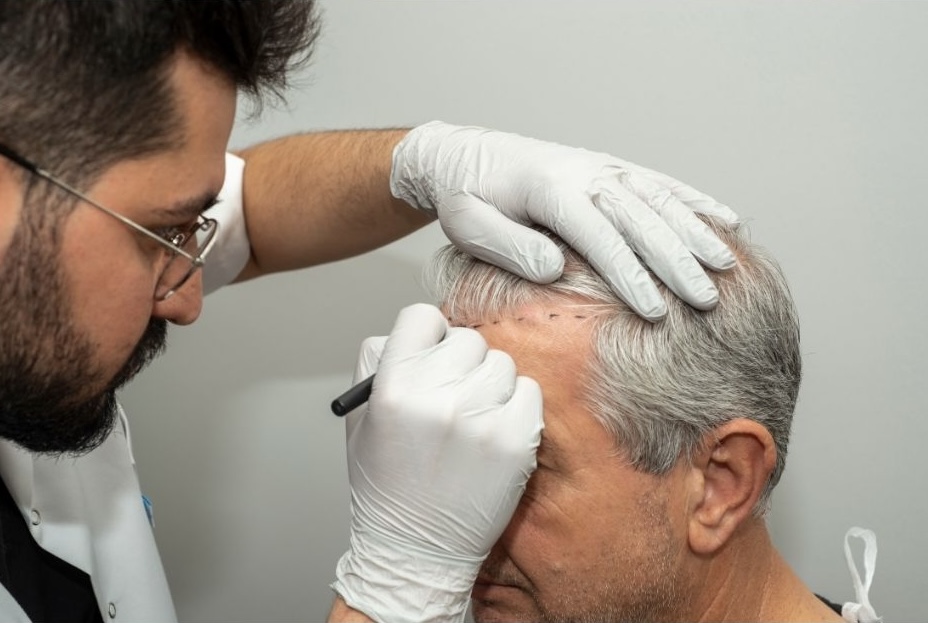
Hair does not fall out at random. In the overwhelming majority of cases — roughly 95% of men and a large share of women with thinning hair — the culprit is a single, well-documented condition called androgenetic alopecia, better known as pattern baldness.
It is not caused by wearing hats, by stress alone, by washing your hair too often, or by your mother's father (more on that myth below). It is caused by a hormone your own body makes, acting on hair follicles that inherited a sensitivity to it.
The three-part machinery of pattern hair loss
Three things have to line up. Remove any one of them and the process stops.
- Testosterone — present in everyone, at higher levels in men.
- 5-alpha reductase — an enzyme in the scalp that converts testosterone into a more potent androgen, dihydrotestosterone (DHT).
- Genetically sensitive follicles — follicles carrying androgen receptors that respond to DHT by shrinking.
When DHT binds to a sensitive follicle, that follicle miniaturises. Each growth cycle it produces a slightly thinner, shorter, lighter hair, and each cycle's growing phase gets shorter. A thick terminal hair becomes a wispy one, then a colourless vellus hair, then nothing at all. The follicle does not die overnight — it fades over years.
The hair growth cycle, and where it breaks
Every follicle runs a repeating three-phase cycle, independently of its neighbours — which is why you don't moult.
| Phase | What happens | Normal duration | % of your hair |
|---|---|---|---|
| Anagen | Active growth. The hair lengthens about 1 cm a month. | 2–7 years | 85–90% |
| Catagen | Transition. The follicle detaches from its blood supply. | 2–3 weeks | ~1% |
| Telogen | Resting, then shedding. The old hair is pushed out by the new one. | 3–4 months | 10–15% |
Losing 50 to 100 hairs a day is completely normal — that's telogen doing its job across roughly 100,000 follicles. Pattern loss doesn't increase shedding dramatically; it shortens anagen so the replacement hair is thinner each time. That is why the change creeps up on people over a decade rather than announcing itself.
The Norwood scale — putting a number on it
Surgeons classify male pattern loss using the Norwood–Hamilton scale, stages I to VII. It matters because your stage determines how much area needs covering and how much donor hair you'll need to cover it.
| Stage | What it looks like | Typical grafts to restore |
|---|---|---|
| I–II | Minor recession at the temples. Considered a normal adult hairline. | 0–800 (often nothing needed) |
| III | Deep temporal recession — the first stage classed as balding. | 800–1,500 |
| III vertex / IV | Recession plus a thinning or open crown. | 1,500–2,800 |
| V | Front and crown bald, separated by a narrowing bridge of hair. | 2,500–3,500 |
| VI | The bridge is gone. Front and crown are one large bald area. | 3,500–5,500 (often two sessions) |
| VII | Only a narrow horseshoe of hair remains at the back and sides. | Donor supply usually cannot cover it fully |
Women follow a different pattern — the Ludwig scale — with diffuse thinning across the top and a preserved frontal hairline. Because the loss is diffuse and the donor area is often affected too, women are candidates for surgery less often than men, and a medical workup matters more.
What is not pattern loss
Before anyone books surgery, other causes have to be ruled out — because most of them are reversible and none of them are fixed by transplanting hair.
- Telogen effluvium — sudden diffuse shedding 2–3 months after a shock: major illness, surgery, childbirth, crash dieting, high fever. Usually recovers on its own within 6–9 months.
- Iron deficiency / thyroid disorders — common, easily tested, easily treated.
- Alopecia areata — an autoimmune condition producing sharply defined round bald patches. Transplanting into it is contraindicated.
- Traction alopecia — mechanical loss from tight braids, weaves or extensions. Reversible early; permanent if scarring sets in.
- Scarring (cicatricial) alopecias — lichen planopilaris, frontal fibrosing alopecia. The follicle is destroyed and replaced by scar tissue. These must be quiet for a long period before any surgery is considered.
- Medication and drug effects — chemotherapy, some retinoids, anticoagulants, anabolic steroids.
Three myths worth deleting
"It comes from your mother's father"
Partly true, badly overstated. The androgen receptor gene sits on the X chromosome, which men inherit from their mother — so the maternal line does carry outsized weight. But over 200 genetic loci have been linked to pattern baldness, many of them not on the X chromosome. Your father's hair matters too. Look at both sides, and look at your own scalp, which is the only evidence that actually counts.
"Hats, gel and frequent washing cause baldness"
None of these reach the follicle bulb, where the damage happens. Washing more often does not cause loss — it simply collects hairs that had already released, which makes shedding look worse than it is.
"Nothing works, so don't bother"
Two drugs have decades of randomised-trial evidence behind them, and transplantation is a mature surgical field. What is true is that nothing regrows a follicle that has fully scarred over. That is why timing beats everything: the earlier you act, the more you keep.
Why timing is the whole game
Miniaturisation is a gradient, not a switch. A follicle producing a thin, weak hair can often be pushed back toward a thicker one with medication. A follicle that has been gone for ten years cannot be revived by anything currently available — it can only be replaced surgically, using a finite donor supply.
So the practical sequence for most people is: confirm the diagnosis, stabilise the loss medically, then consider surgery for the area that is already bare. Doing surgery without stabilising is how people end up with a transplanted hairline floating above a scalp that kept receding behind it.
Key takeaways
- Around 95% of male hair loss is androgenetic alopecia — DHT shrinking genetically sensitive follicles over years.
- Follicles at the back and sides are DHT-resistant and keep that resistance when moved. This 'donor dominance' is why transplants work at all.
- Losing 50–100 hairs a day is normal; pattern loss thins hair rather than dramatically increasing shedding.
- Rule out thyroid problems, iron deficiency, telogen effluvium and scarring alopecias before considering surgery.
- Early action preserves options. Miniaturised follicles can respond to treatment; long-dead ones can only be replaced.
All ten topics
- 1. Why Hair Actually Falls Out (you are here)
- 2. FUE vs FUT: The Only Real Choice
- 3. DHI, Sapphire, Bio-FUE: Buzzwords Decoded
- 4. Are You Actually a Good Candidate?
- 5. How Many Grafts Do You Actually Need?
- 6. The 18-Month Timeline, Month by Month
- 7. Hairline Design: Where Results Are Won or Lost
- 8. Medication vs Surgery — Why You Need Both
- 9. Cost, Clinics and Hair Transplant Tourism
- 10. Risks, Complications and Real Recovery