Topic 10 of 10
Risks, Complications and Real Recovery
Hair transplantation is safe surgery, but it is surgery. Informed consent means knowing the failure modes, not just the success photos.
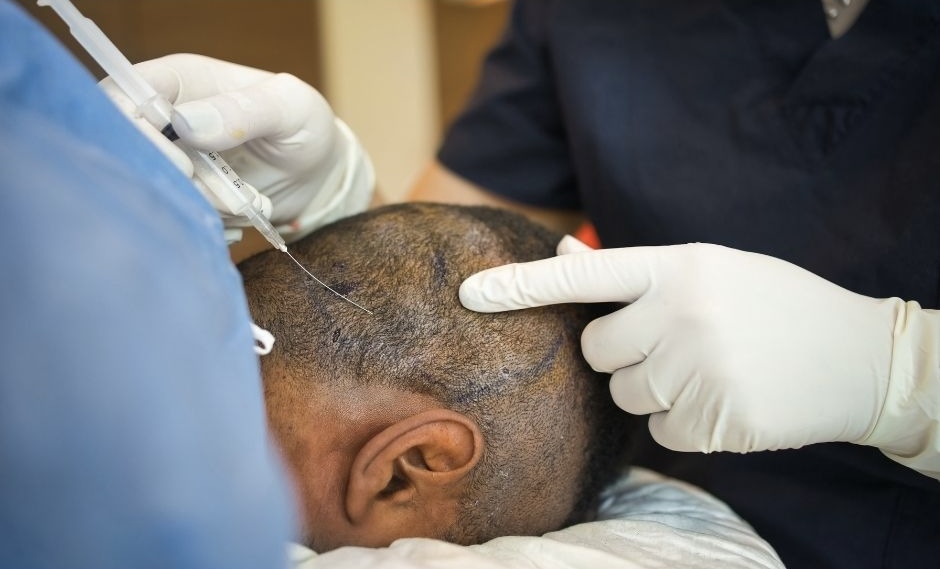
In competent hands, hair transplantation has a strong safety record. It is performed under local anaesthetic, on a well-vascularised area, without entering a body cavity. Serious complications are uncommon.
But 'uncommon' is not 'never', and the most damaging outcomes in this field are not medical emergencies — they are permanent cosmetic errors that no one warned the patient about.
Common and expected
These happen to most patients and resolve on their own. They are part of the process rather than complications.
- Swelling of the forehead and around the eyes, days 2–5.
- Scabbing and redness in the recipient area for 7–14 days; residual pinkness for weeks longer on fair skin.
- Numbness at the donor site — weeks after FUE, sometimes several months after FUT.
- Itching during healing.
- Shedding of transplanted hair at weeks 2–6 — universal and expected.
- Shock loss of surrounding native hair, usually recovering over 3–6 months.
- Folliculitis — small spots as hairs emerge, months 2–5.
Uncommon complications
| Complication | Roughly | What it means |
|---|---|---|
| Infection | <1% | The scalp's blood supply makes it rare. Presents as spreading redness, warmth, pus, fever. Needs prompt antibiotics. |
| Excessive bleeding | <1% | Usually linked to anticoagulants, aspirin, alcohol or undisclosed bleeding disorders. |
| Ingrown hairs / cysts | Occasional | Grafts buried too deep. Usually settle; sometimes need minor drainage. |
| Hypertrophic or keloid scarring | Rare | Higher risk with a personal or family history, and in FUT. Disclose it. |
| Prolonged numbness or neuralgia | Uncommon | Nerve irritation, mostly after FUT. Usually resolves over months. |
| Anaesthetic reaction | Rare | Lidocaine toxicity is possible in very long sessions with large volumes — a reason to question mega-sessions. |
| Scalp necrosis | Very rare | Tissue death from compromised blood supply. Associated with over-dense packing, smoking, diabetes and adrenaline overuse. Causes permanent scarring. |
| Arteriovenous fistula | Very rare | An abnormal vessel connection at the donor site; needs surgical correction. |
The cosmetic failures that matter more
Statistically these are far more likely than any medical complication, and unlike infection they are often permanent.
Poor graft survival
Grafts that never grow. Causes are almost always procedural: excessive time out of the body, poor holding solution, crush injury during handling, transection during extraction, drying, or packing so densely the blood supply can't support the grafts. You won't know until month 12, by which time the donor hair is spent. This is the strongest argument for choosing on quality rather than price.
Over-harvested donor area
Taking too many grafts, taking them from outside the safe zone, or using an oversized punch leaves the back and sides visibly thin, patchy or 'moth-eaten' at short lengths. This is permanent and largely uncorrectable — scalp micropigmentation can camouflage it, but the hair does not come back. It is the most common serious harm in the high-volume market, and it is caused by chasing a big graft number.
Unnatural design
A hairline too low or too straight, multi-hair grafts at the front edge, wrong angles, a pluggy appearance. Correcting it means graft excision and re-implantation — expensive, imperfect, and costly in donor hair.
The stranded island
A transplant placed without medical therapy in a young patient with progressive loss. In ten years the native hair behind the grafts is gone and the transplanted zone sits alone. Fixable only by further surgery, if donor supply remains.
Practical recovery, week by week
Days 1–3
- Sleep at 45° on a travel pillow. Reduces swelling substantially.
- No touching the grafts. None.
- Prescribed painkillers and any antibiotic as directed. Avoid aspirin and ibuprofen unless your surgeon says otherwise.
- No alcohol, no smoking, no strenuous activity, no bending over.
Days 4–10
- Begin the clinic's washing protocol exactly as instructed — usually a gentle lotion, left to soften scabs, rinsed with cupped water rather than a shower jet.
- Do not pick scabs. Picking before day 10 removes the graft with the scab.
- Light walking is fine. No gym, no running, no swimming, no sauna.
- Keep the scalp out of direct sun; a loose hat only if it doesn't touch the grafts, and only after your surgeon clears it.
- FUT sutures or staples usually come out around day 10.
Weeks 2–4
- Scabs should have cleared. Normal gentle shampooing resumes.
- Light exercise from around week 2; full training usually around week 4 — confirm with your clinic.
- The transplanted hair sheds. Expected.
- Swimming and sauna typically from week 4.
- Scissor trimming of the recipient area from about week 4; no razor or clippers on the recipient area for several months. The donor can usually be clipped earlier.
Months 2 onwards
- Resume or continue finasteride and minoxidil as prescribed — typically restarting minoxidil on the recipient area at around week 4.
- Sun protection for the healing scalp for several months.
- Monthly photographs in identical lighting and position.
- Formal review with your surgeon at 6 and 12 months.
When to contact the clinic urgently
- Fever, or spreading redness, warmth or pus.
- Pain that is increasing rather than decreasing after day 3.
- Bleeding that doesn't stop with 10–15 minutes of gentle pressure.
- Swelling that is severe, one-sided, or worsening after day 5.
- A dark, dusky or blackened patch of scalp — potential necrosis, and time-critical.
Everything else — itching, spots, shedding, patchy early growth, asymmetry at month 4 — is normal, and answers itself with time.
Key takeaways
- Serious medical complications are rare — infection under 1%, necrosis very rare. The scalp heals exceptionally well.
- Cosmetic failures are far more likely and often permanent: poor graft survival, over-harvested donor, bad design.
- Over-harvesting the donor area is the signature harm of high-volume, high-graft-count selling. It cannot be undone.
- The riskiest period is days 1–10, when grafts can be physically dislodged. After that they are secure.
- Urgent signs: fever, spreading redness, increasing pain, uncontrolled bleeding, or a dark patch of scalp.
All ten topics
- 1. Why Hair Actually Falls Out
- 2. FUE vs FUT: The Only Real Choice
- 3. DHI, Sapphire, Bio-FUE: Buzzwords Decoded
- 4. Are You Actually a Good Candidate?
- 5. How Many Grafts Do You Actually Need?
- 6. The 18-Month Timeline, Month by Month
- 7. Hairline Design: Where Results Are Won or Lost
- 8. Medication vs Surgery — Why You Need Both
- 9. Cost, Clinics and Hair Transplant Tourism
- 10. Risks, Complications and Real Recovery (you are here)