Topic 7 of 10
Hairline Design: Where Results Are Won or Lost
You can transplant perfect grafts with perfect survival and still produce an obviously fake result. Design is the artistry, and it happens before the first incision.
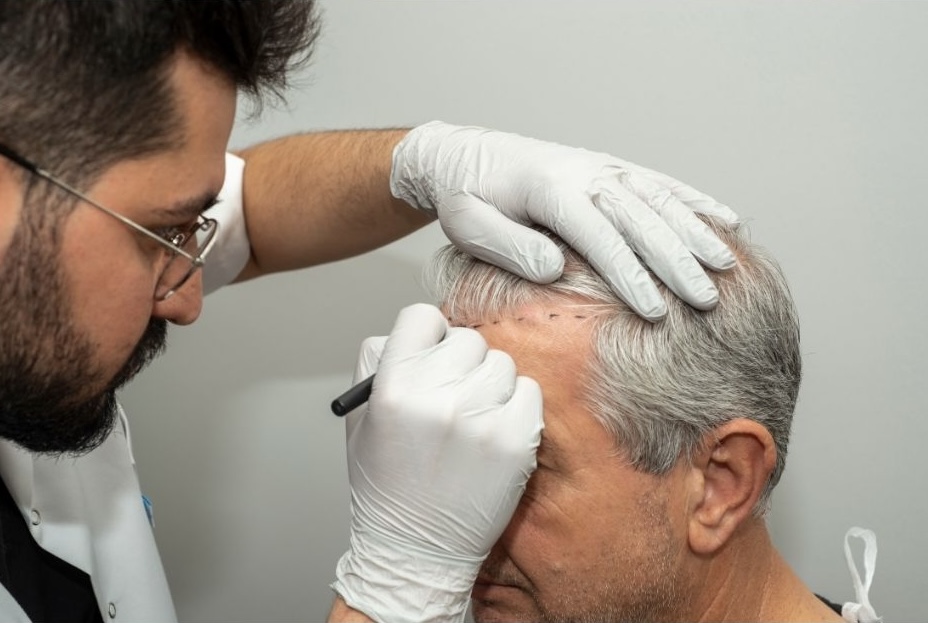
When someone can tell at a glance that a person has had a hair transplant, it is almost never because the grafts failed. It is because the hairline was designed badly — too low, too straight, too dense at the edge, or angled wrongly.
Design is decided in a 20-minute conversation with a marker pen, and you live with it for 40 years. Treat it as the most important part of the consultation.
The mature hairline
Everyone's hairline recedes somewhat after adolescence. The mature hairline — the adult resting position — sits roughly 1 to 2 cm above the highest forehead crease, with softened temple recession. That is not balding; it is the normal adult male hairline, and it is the correct reference point for design.
Rebuilding a juvenile hairline — low, flat, no temporal recession — is the most common design error. It looks plausible at 28 and conspicuous at 50, and it consumes a large number of grafts across the widest part of the scalp, grafts you will want later for the mid-scalp.
The landmarks surgeons use
- Mid-frontal point — the centre of the hairline. Commonly placed 7–11 cm above the glabella (the point between the eyebrows), varying with face height and shape.
- Frontotemporal angles — where the hairline meets the temples. These should sit on or behind a vertical line dropped from the outer edge of the eye socket.
- Temporal peaks — the small forward projections at each side. Keeping them soft and slightly recessed reads as natural.
- The rule of thirds — a face divided into hairline-to-brow, brow-to-nose-base, nose-base-to-chin. Roughly equal thirds looks balanced; a hairline set to make the upper third obviously shortest looks wrong even if the observer can't say why.
- Facial shape — a rounded hairline suits a long face; a flatter one suits a rounder face.
Why a natural hairline is irregular
Real hairlines are not lines. They are transition zones, several millimetres deep, with a deliberate irregularity that the eye reads as natural.
- Single-hair grafts only at the front edge. The leading 1–2 rows must be one-hair follicular units. A two-hair graft in the front row produces a visible tuft — the classic 'doll's hair' or 'toothbrush' look of 1990s surgery.
- Irregular, sawtooth border. A deliberately uneven edge with small macro-irregularities (gentle peaks and bays) and micro-irregularities (individual hairs sitting slightly forward or back).
- Sentinel hairs. A scatter of isolated single hairs a few millimetres ahead of the main line, mimicking the natural fade-out.
- Graduated density. Sparse at the very front, denser 5–10 mm behind. A hard, uniformly dense edge is the giveaway.
- Graded graft sizing. Singles at the front, then doubles, then three- and four-hair units in the mid-scalp where bulk is needed and nobody sees the edge.
Angle and direction — the invisible half
Hair does not emerge perpendicular to the scalp. Getting this wrong produces hair that stands up, refuses to style, and catches light unnaturally — and it cannot be corrected without removing and replacing grafts.
- Frontal hairline: acute forward angle, roughly 15–30° to the scalp surface, pointing forward and slightly down.
- Temples: very flat, 10–20°, sweeping backward and downward. The most technically demanding area.
- Mid-scalp: forward, gradually steepening.
- Crown: must follow the natural whorl — a spiral, usually clockwise. Reproducing this correctly is the hardest part of crown work and the main reason crowns look artificial.
Recipient site incisions are what set angle and direction; the graft simply follows the slot it's placed in. This is why site creation is usually done by the surgeon personally, even in clinics where technicians handle the rest.
Coronal vs sagittal incisions
A detail worth knowing because it's a good consultation question. Sagittal (parallel to hair direction) sites are more forgiving and allow tighter packing. Coronal (perpendicular) sites give better control over the hair's fanning direction and can produce more visual coverage per graft, at the cost of technical difficulty. Many surgeons use coronal at the hairline and sagittal behind it. Either can produce excellent work; a surgeon who has a considered reason for their choice is a good sign.
Red flags in a proposed design
- A hairline drawn below the highest forehead crease, or straight across with no temporal recession.
- The surgeon asks you where to put it and draws exactly what you ask, without discussing age progression.
- No discussion of what happens behind the line as your loss advances.
- Density promised uniformly 'like it was at 20'.
- Crown work planned in a patient under 30 with an aggressive family history.
- The line is drawn in under five minutes, without you sitting upright and being shown it in a mirror, from several angles.
- You are not asked to approve the drawn line in a photograph before surgery begins.
Key takeaways
- Design, not graft survival, is what makes a transplant look obviously done.
- A mature hairline sits 1–2 cm above the highest forehead crease and keeps softened temple recession.
- The front edge must be single-hair grafts in an irregular, graduated transition zone — never a dense straight line.
- Angles matter as much as position: 15–30° forward at the hairline, flat at the temples, whorled at the crown.
- Photograph the drawn hairline from several angles and approve it before surgery. It is the last reversible step.
All ten topics
- 1. Why Hair Actually Falls Out
- 2. FUE vs FUT: The Only Real Choice
- 3. DHI, Sapphire, Bio-FUE: Buzzwords Decoded
- 4. Are You Actually a Good Candidate?
- 5. How Many Grafts Do You Actually Need?
- 6. The 18-Month Timeline, Month by Month
- 7. Hairline Design: Where Results Are Won or Lost (you are here)
- 8. Medication vs Surgery — Why You Need Both
- 9. Cost, Clinics and Hair Transplant Tourism
- 10. Risks, Complications and Real Recovery