Topic 5 of 10
How Many Grafts Do You Actually Need?
Grafts are the currency of this operation. Knowing how the count is calculated is the single best defence against being oversold.
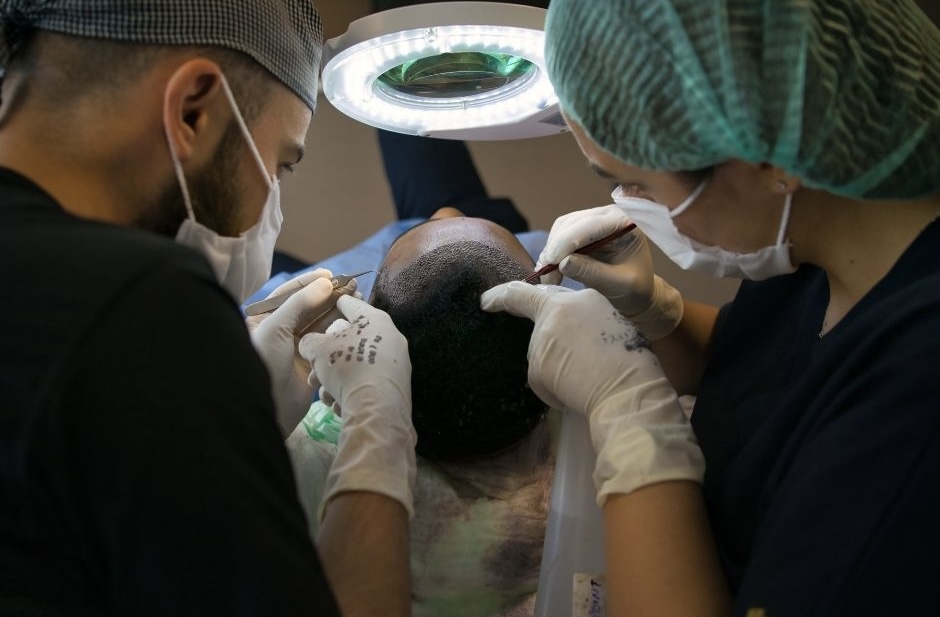
Almost everything about a hair transplant — the price, the session length, the realistic result — is driven by one number: the graft count. And it is the number clinics most often quote loosely, because you cannot verify it after the fact.
So learn the arithmetic.
Graft ≠ hair
A graft is one follicular unit, containing 1 to 4 hairs. A quote of 3,000 grafts might mean 5,400 hairs (poor donor, 1.8 hairs/unit) or 7,500 hairs (excellent donor, 2.5 hairs/unit). Same price, 40% more hair.
This is the field's favourite ambiguity. Some clinics — particularly in high-volume markets — quote in hairs rather than grafts, making a 2,000-graft procedure sound like 5,000. Always ask: "Is that number follicular units, or individual hairs?" Get the answer in writing.
How surgeons calculate the number
The honest method has three steps.
- Measure the area to be covered in cm². A receded hairline zone might be 30–50 cm². A bald crown is typically 50–80 cm². A full Norwood VI top can exceed 200 cm².
- Choose a target density in follicular units per cm². Hairline and frontal zone: 35–50. Mid-scalp: 30–40. Crown: 25–35 (whorl patterns hide lower density well).
- Multiply, then adjust for hair calibre, colour contrast, curl, existing native hair in the zone, and the surgeon's realistic yield.
If a clinic gives you a graft number without measuring your scalp or examining your donor density, they generated it from a photograph and a price list.
Typical ranges by zone
| Zone | Area | Grafts (one pass) |
|---|---|---|
| Hairline + temples only | 20–40 cm² | 800–1,500 |
| Frontal third | 40–60 cm² | 1,500–2,200 |
| Frontal + mid-scalp | 70–110 cm² | 2,200–3,200 |
| Crown alone | 50–80 cm² | 1,500–2,500 |
| Full top (front + mid + crown) | 150–220 cm² | 4,000–6,000, usually staged |
| Temple points (refinement) | small | 200–500 |
| Beard, eyebrows, scar camouflage | small | 150–1,200 |
Typical ranges by Norwood stage
| Norwood | Grafts, first session | Notes |
|---|---|---|
| II–III | 800–1,800 | Hairline restoration; often the highest satisfaction per graft. |
| III vertex | 1,500–2,500 | Front prioritised; crown often deferred. |
| IV | 2,000–3,000 | Bridge preservation matters. |
| V | 2,500–3,500 | Front and mid-scalp; crown a second stage if donor allows. |
| VI | 3,500–5,000+ | Realistically two sessions. Full coverage may be impossible. |
| VII | Donor-limited | Coverage of front only, or consider SMP / systems instead. |
Five ways graft counts get inflated
- Quoting hairs as grafts. The most common. 4,000 'grafts' that are actually ~1,700 units.
- Counting transected and non-viable grafts in the total. Split follicles that will never grow still get counted at the desk.
- Packing beyond safe density. Over-dense placement outstrips the scalp's blood supply, and grafts die. More is not better past about 45–50 FU/cm².
- Harvesting outside the safe donor zone to hit a big headline number. Those grafts are DHT-sensitive and will fall out years later, permanently thinning the donor area for nothing.
- Flat-rate 'unlimited grafts' packages. There is no incentive to be precise, and every incentive to over-harvest.
How to verify what you actually got
You can't count 3,000 grafts yourself, but you can make counting harder to fudge:
- Ask for the graft count sheet — reputable clinics tally singles, doubles, triples and quadruples separately during dissection, and will give you a copy.
- Request photos of the graft trays before implantation.
- Ask for the count to be broken down by hairs per unit, in writing, in your operative record.
- Photograph your own donor area before and after, in the same lighting. Extraction density is visible.
- Ask for recipient site counts — sites are made before placement and are countable in photographs.
Planning for a second session
Most people with Norwood IV or above will have two procedures. Sequencing them well matters more than maximising the first one.
- Leave 12 months minimum between sessions — you need to see the final result of pass one before planning pass two.
- Expect the second session to be smaller (1,000–2,500) and aimed at increasing density in the first zone or extending backwards.
- Keep a lifetime reserve. Never spend your entire donor area in one operation at 30, whatever the pattern looks like at the time.
- Stay on medical therapy throughout. Grafts placed into a receding native field will look isolated when that native hair goes.
Key takeaways
- A graft is a follicular unit of 1–4 hairs. Always confirm whether a quote counts grafts or hairs.
- Honest counts come from measuring area in cm² and multiplying by a target density of 25–50 FU/cm².
- Typical first sessions: 800–1,800 for a hairline, 2,200–3,200 for front plus mid-scalp, 3,500+ for advanced loss.
- Prioritise the front. The crown is a graft sink that grows with age.
- Ask for the dissection count sheet and tray photos — the request alone changes how carefully you're counted.
All ten topics
- 1. Why Hair Actually Falls Out
- 2. FUE vs FUT: The Only Real Choice
- 3. DHI, Sapphire, Bio-FUE: Buzzwords Decoded
- 4. Are You Actually a Good Candidate?
- 5. How Many Grafts Do You Actually Need? (you are here)
- 6. The 18-Month Timeline, Month by Month
- 7. Hairline Design: Where Results Are Won or Lost
- 8. Medication vs Surgery — Why You Need Both
- 9. Cost, Clinics and Hair Transplant Tourism
- 10. Risks, Complications and Real Recovery