Topic 6 of 10
The 18-Month Timeline, Month by Month
Most people who regret their transplant are between month 2 and month 5. Almost none of them still regret it at month 14.
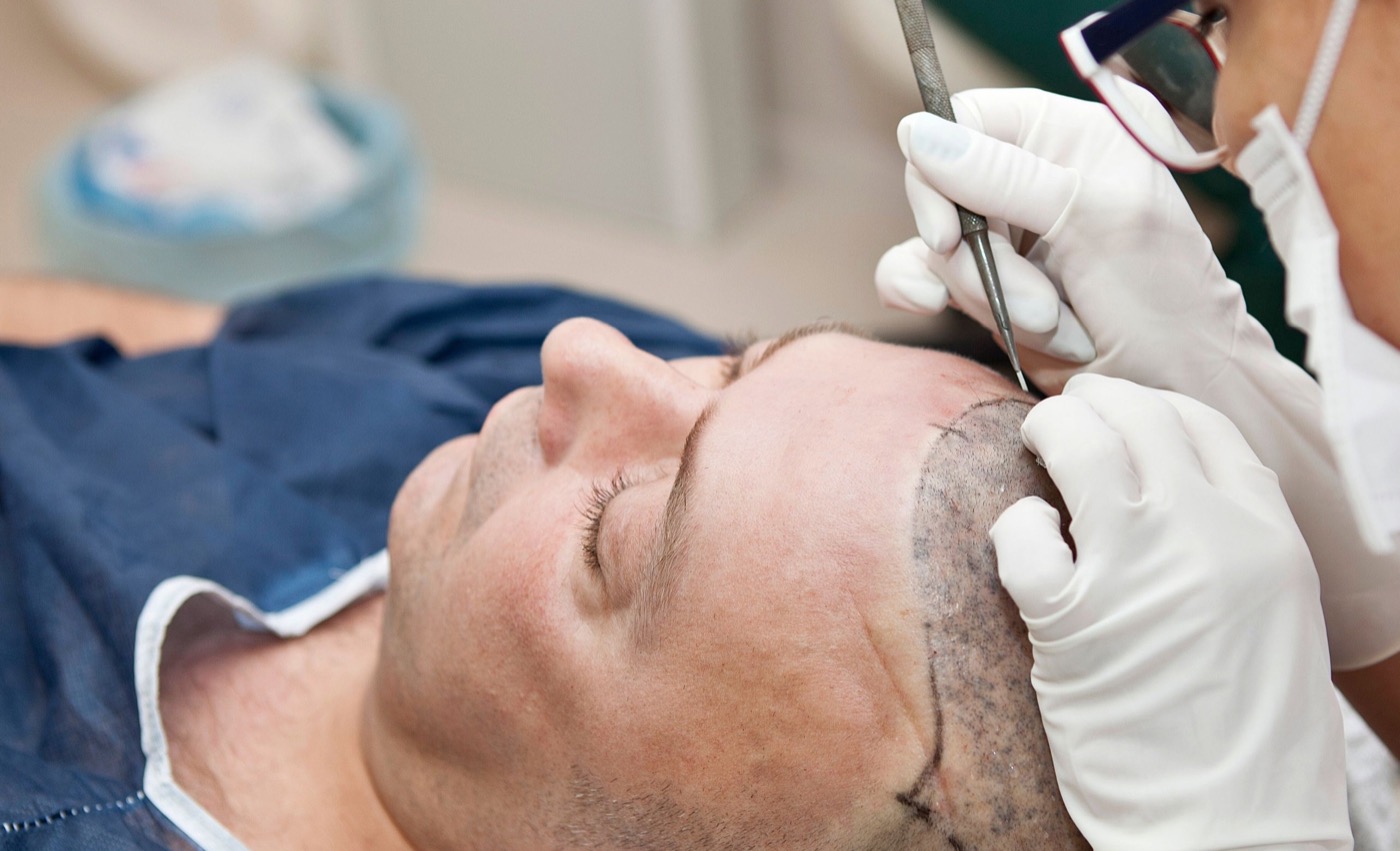
A hair transplant is the slowest-acting cosmetic procedure in common use. You pay in full on day one and see the result more than a year later. Knowing the schedule in advance is the difference between a difficult few months and a panicked call to the clinic at week 6.
Day 0 — surgery
Six to twelve hours under local anaesthetic, awake, usually with breaks for food and the bathroom. The injections at the start are the uncomfortable part; after that you should feel pressure and movement but not pain. Expect the recipient area to look raw and dotted with tiny scabs by the end, and the donor area to be red and shaved.
Days 1–7 — the visible phase
- Swelling peaks around days 2–4, often migrating down to the forehead and occasionally the eyes. It looks alarming and resolves completely. Sleeping at 45° and cold compresses on the forehead (never on the grafts) help.
- Scabs form around each graft. They are the visible sign of surgery and the reason most people take 7–10 days off.
- Redness across the recipient area — more pronounced and longer-lasting on pale skin.
- Numbness and tightness at the donor site, especially after FUT.
- Gentle washing usually begins at day 2–4 exactly as the clinic instructs. This is the highest-risk window: grafts are not yet secure.
Weeks 2–4 — shedding (this is normal)
Between week 2 and week 6, the transplanted hairs fall out. Nearly all of them. This is expected and it is not failure.
The transplanted hair shaft is discarded; the follicle survives beneath the skin and enters a resting phase before starting a new growth cycle. Nobody enjoys watching it, but a transplant that didn't shed would be the unusual one.
Shock loss
Some native hairs in and around the recipient area also shed, triggered by the trauma of surgery. This is shock loss (surgical telogen effluvium). It typically appears at weeks 3–8 and usually recovers over 3–6 months. Hairs that were already miniaturised may not come back — which is why operating on a heavily thinning area rather than a bald one carries more risk of a temporary net-worse appearance.
Months 2–4 — the ugly duckling phase
This is the low point, and it is worth naming clearly. The transplanted hair has shed, some native hair has shed with it, the redness may not have fully faded, and nothing new has emerged. Many people look worse than before surgery at month 3.
Other things happening in this window:
- Folliculitis — small pimple-like spots as new hairs push through. Common, usually self-limiting; the clinic should see anything painful or spreading.
- Itching as nerves regenerate and skin heals.
- Persistent numbness at the donor site, particularly after FUT — often several months.
- Patchy early sprouts from about week 10, emerging thin, colourless and unevenly.
Nothing here predicts your final result. Judging a transplant at month 3 is like judging a building from its foundation trench.
Months 4–6 — growth begins
New hairs emerge in earnest, but they come through thin, wispy and often lighter in colour than your existing hair, and they arrive asynchronously — follicles don't restart in unison. Expect patchiness. By month 6 most people see roughly 30–50% of the final result and start to feel reassured.
Months 6–9 — thickening
Emerged hairs gain calibre and pigment; the late-starting follicles catch up. Coverage becomes clearly better than baseline. Around 60–70% of the final outcome. This is when most people stop thinking about it daily.
Months 9–12 — the result arrives
Density and texture keep improving. At 12 months you're looking at roughly 80–90% of the final result — the point at which most clinics take their official 'after' photograph, and a fair point to judge the outcome.
Months 12–18 — maturation
The last gains are in shaft thickness rather than new hairs, and in how the hair behaves — it starts to lie and style naturally rather than standing up. Crown work and coarse or curly hair take the longest, sometimes past 18 months. Judge a transplant at 12–18 months, not before.
| Time | What you see | % of final result |
|---|---|---|
| Week 1 | Scabs, swelling, redness | — |
| Weeks 2–6 | Transplanted hair sheds; possible shock loss | 0% |
| Months 2–4 | Ugly duckling phase — often worse than baseline | 0–10% |
| Months 4–6 | Thin, patchy new growth | 30–50% |
| Months 6–9 | Thickening, pigment returning | 60–70% |
| Months 9–12 | Cosmetically strong, clearly improved | 80–90% |
| Months 12–18 | Full calibre, natural styling behaviour | 100% |
What helps, and what doesn't
Genuinely worth doing
- Follow the clinic's washing protocol precisely for the first two weeks.
- Sleep elevated for 5–7 nights.
- Stay on finasteride and/or minoxidil if prescribed — they protect the native hair around your grafts.
- Stop smoking for at least 2 weeks before and 4 weeks after.
- Avoid alcohol for the first week, direct sun for a month, and swimming pools until fully healed.
- Take photographs monthly in identical lighting. Progress is invisible day to day and obvious in a series.
Doesn't change the outcome
- Special shampoos, oils and 'post-transplant' supplement packs sold at the clinic.
- Massaging the grafts to 'stimulate' growth.
- Comparing yourself to someone else's month-4 photos on a forum — hair type, graft count and lighting differ.
Key takeaways
- Transplanted hair sheds at weeks 2–6. This is normal and expected — the follicle stays.
- Months 2–4 are the 'ugly duckling' phase, when you may look worse than before surgery.
- Real growth starts at month 4; expect roughly 50% at 6 months, 80–90% at 12 months, final at 12–18.
- Grafts are vulnerable for the first 7–10 days only. After that, they cannot be dislodged.
- Judge your result at 12–18 months. Monthly photos in the same lighting are the only reliable measure.
All ten topics
- 1. Why Hair Actually Falls Out
- 2. FUE vs FUT: The Only Real Choice
- 3. DHI, Sapphire, Bio-FUE: Buzzwords Decoded
- 4. Are You Actually a Good Candidate?
- 5. How Many Grafts Do You Actually Need?
- 6. The 18-Month Timeline, Month by Month (you are here)
- 7. Hairline Design: Where Results Are Won or Lost
- 8. Medication vs Surgery — Why You Need Both
- 9. Cost, Clinics and Hair Transplant Tourism
- 10. Risks, Complications and Real Recovery