Topic 2 of 10
FUE vs FUT: The Only Real Choice
Every other technique name is marketing. Underneath, there are exactly two ways to harvest hair — and they suit different people.
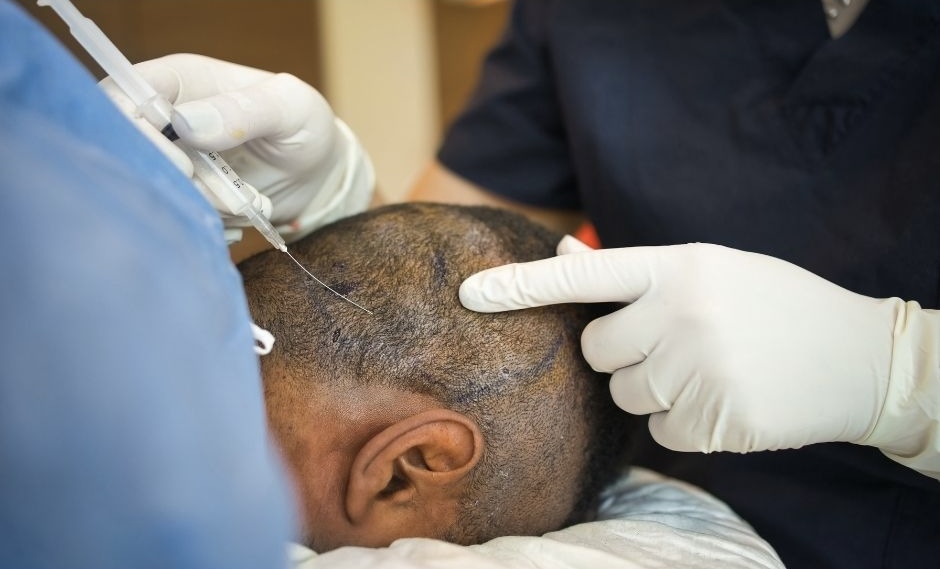
Modern hair transplantation moves follicular units — the natural bundles of 1 to 4 hairs that grow together, along with their sebaceous glands and tiny erector muscle. Both methods move the same units and produce the same implanted result. The only difference is how the units come out of the back of your head.
FUT — Follicular Unit Transplantation (the 'strip' method)
The surgeon removes a thin horizontal strip of scalp from the permanent donor zone at the back of the head, then closes the gap with sutures. Under microscopes, a team of technicians dissects the strip into individual follicular units.
It leaves a single linear scar, typically 1–3 mm wide, running side to side. With a modern trichophytic closure, hair grows through the scar line, which hides it well — but it is permanent and it becomes visible if you shave the back of your head.
Why some surgeons still prefer it
- Highest yield per graft. Microscopic dissection under direct vision damages very few follicles. Survival rates are consistently excellent.
- Preserves donor density for the future. FUE thins the whole donor area; FUT takes from one band and leaves the surrounding density untouched, which matters if you may need several sessions over a lifetime.
- Better in coarse, curly or Afro-textured hair, where follicles curve sharply under the skin and blind punch extraction transects them more often.
- Faster and usually cheaper per graft.
FUE — Follicular Unit Excision
Instead of a strip, the surgeon uses a punch of 0.7–1.0 mm to core out each follicular unit individually, one at a time — often 2,000 to 4,000 of them in a session. The tiny circular wounds are left to heal on their own.
The result is hundreds of dot scars rather than one line. Each is small enough to be invisible at conversational distance, and a grade 2 or 3 buzz cut normally hides them completely. Go shorter than that and, if the punches were oversized or over-harvested, they can show as a moth-eaten look.
Why it dominates the market
- No linear scar — the single reason most patients choose it. You can wear your hair short.
- Faster, more comfortable recovery. No sutures, no tightness, no numbness across the back of the head, back to a desk job in a few days.
- Body and beard hair can be harvested to supplement a depleted scalp donor area in advanced cases.
- Better for patients with tight scalps, where a strip closure would be under tension.
Side by side
| FUT (strip) | FUE | |
|---|---|---|
| Scarring | One fine linear scar, permanent | Hundreds of ~1 mm dot scars, diffuse |
| Can you shave your head after? | No — the line shows | Usually yes at grade 2–3 |
| Graft survival | Excellent (microscope-dissected) | Very good; more operator-dependent |
| Transection risk | Low | Higher, especially with curly hair or a fast punch |
| Session length | 4–8 hours | 6–12 hours, sometimes split over two days |
| Recovery | 10–14 days, sutures out at ~10 days | 5–7 days, no sutures |
| Post-op discomfort | Moderate tightness and numbness | Mild soreness |
| Donor shaving needed | Only a narrow band | Usually the whole back and sides |
| Cost per graft | Lower | Higher (10–40% more typically) |
| Lifetime donor capacity | Higher if strips are the main route | Higher if combined with FUT over time |
So which one should you pick?
FUE tends to suit you if
- You wear your hair short, or want the option to.
- You need a fast return to work or the gym.
- Your loss is early-stage and the graft count is moderate.
- You have a tight scalp, or a previous strip scar you'd rather not extend.
- You are covering scars — including a previous FUT scar.
FUT tends to suit you if
- You have advanced loss (Norwood V–VII) and need maximum grafts from a limited donor area.
- You keep your hair medium or long and will never buzz it.
- You have coarse, curly or Afro-textured hair.
- Budget is a real constraint and you want the most grafts per pound or dollar.
- You anticipate multiple sessions over decades and want to protect overall donor density.
Many experienced surgeons now do both in one patient over time — a strip first to bank a large number of grafts efficiently, then FUE later for refinement. Any clinic that only offers one method will, unsurprisingly, tell you that method is best for everyone. That is a signal in itself.
What about robotic and motorised systems?
Devices like ARTAS assist FUE punching with image guidance, and motorised or suction-assisted punches speed up manual extraction. They can improve consistency and reduce surgeon fatigue on long cases. They do not change the underlying biology, they do not eliminate dot scarring, and they do not make a poorly planned hairline look good. Treat them as tools, not as a different operation.
Common questions
Can the FUT scar be removed later?
Not removed, but usually improved. Options include scar revision surgery, FUE grafts implanted directly into the scar tissue, and scalp micropigmentation to camouflage the line. Grafts into scar tissue survive less reliably than into normal scalp because of the poorer blood supply, so expect partial improvement rather than erasure.
Is FUE really 'scarless'?
No, and any clinic claiming that is misleading you. FUE trades one visible line for many small round scars. They are far less conspicuous — but if a clinic over-harvests, or uses punches larger than about 1 mm, the donor area can look visibly thinned or speckled at short lengths. This is permanent.
Does FUE hurt less than FUT?
During surgery both are done under local anaesthetic and neither should hurt beyond the initial injections. Afterwards FUE is noticeably more comfortable — FUT patients commonly report a tight, pulling sensation and numbness at the back of the scalp for several weeks to months as nerves recover.
Key takeaways
- FUT and FUE differ only in harvesting. Everything implanted into the recipient area is identical.
- FUT leaves one thin linear scar but preserves donor density and gives excellent yield — best for advanced loss and longer hairstyles.
- FUE leaves diffuse dot scars, recovers faster and lets you wear short hair — best for early-to-moderate loss.
- Neither is 'scarless'. Choose which kind of scar you'd rather have.
- Surgeon skill and graft handling outweigh the choice of technique by a wide margin.
All ten topics
- 1. Why Hair Actually Falls Out
- 2. FUE vs FUT: The Only Real Choice (you are here)
- 3. DHI, Sapphire, Bio-FUE: Buzzwords Decoded
- 4. Are You Actually a Good Candidate?
- 5. How Many Grafts Do You Actually Need?
- 6. The 18-Month Timeline, Month by Month
- 7. Hairline Design: Where Results Are Won or Lost
- 8. Medication vs Surgery — Why You Need Both
- 9. Cost, Clinics and Hair Transplant Tourism
- 10. Risks, Complications and Real Recovery