Topic 8 of 10
Medication vs Surgery — Why You Need Both
Surgery replaces hair you've already lost. Medication protects the hair you still have. Doing only one of them is the most expensive mistake in this field.
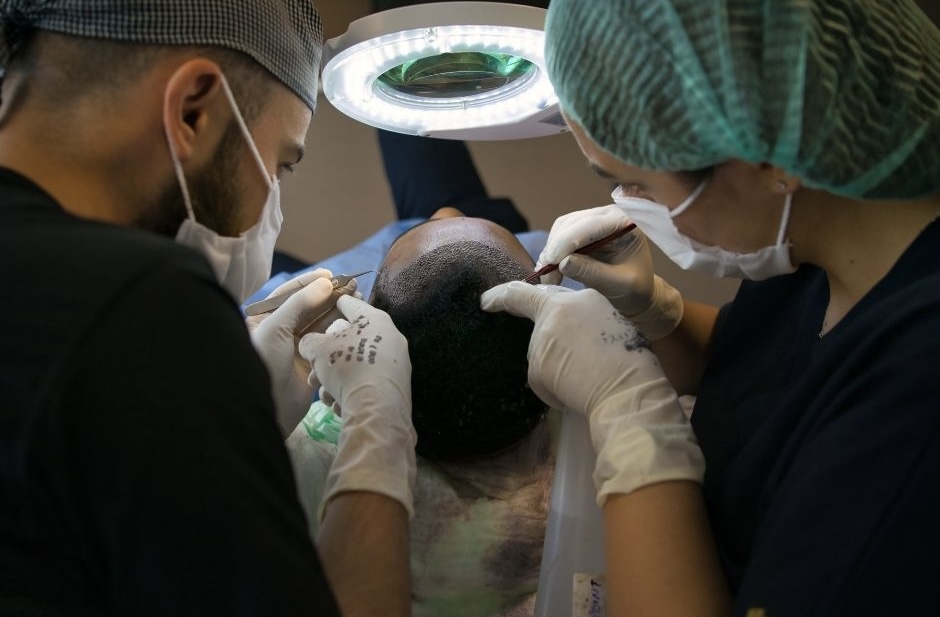
There is a persistent belief that a transplant is a permanent, one-and-done fix. It isn't — not because grafts fail, but because the operation does nothing to slow the disease. Pattern loss keeps progressing in the native hair around and behind your grafts.
The result, if untreated, is predictable: a transplanted frontal zone that survives beautifully while the hair behind it disappears, leaving a visible island. People then return for a second surgery to fill the gap, then a third. Each one spends donor hair that medication could have preserved for free.
The two proven drugs
Finasteride (oral, 1 mg daily)
A 5-alpha-reductase type II inhibitor. It blocks the conversion of testosterone to DHT, lowering scalp DHT by roughly 60–70% and removing the signal that drives miniaturisation.
- Approved for male pattern hair loss and supported by large randomised controlled trials over 5+ years.
- In trials, around 80–90% of men stopped losing further hair, and roughly 60% saw measurable regrowth.
- Works best on the crown and mid-scalp; less dramatic at the frontal hairline.
- Takes 6–12 months for a visible effect. Judging it earlier is judging noise.
- Effects are entirely dependent on continued use. Stop, and accumulated benefit is lost within roughly 12 months.
Side effects — the honest version
In randomised trials, sexual side effects (reduced libido, erectile difficulty, reduced ejaculate volume) occurred in about 1.5–3.8% of men, versus about 1.5–2.1% on placebo — a small absolute difference. Most resolve on stopping, and many resolve while continuing.
A contested minority report persistent symptoms after discontinuation ('post-finasteride syndrome'). Its existence, mechanism and frequency are genuinely disputed in the literature, and you'll find confident claims in both directions online. What can be said fairly: the risk is low but not zero, it is worth discussing with a doctor rather than a forum, and it is your decision to make with informed consent. Finasteride is also contraindicated in women who are or may become pregnant, and it lowers PSA readings — tell any doctor ordering that test.
Topical finasteride is an increasingly common alternative, aiming for scalp effect with lower systemic absorption. Early evidence is reasonably encouraging; long-term data is thinner.
Minoxidil (topical 5%, or low-dose oral)
Originally a blood-pressure drug; the hair effect was a side effect. It works through a different mechanism — vasodilation and potassium-channel opening — that extends the anagen growth phase and increases shaft calibre. It does nothing about DHT.
- Over-the-counter, approved for men and women.
- Because the mechanism is different from finasteride's, the two are complementary — combination therapy consistently outperforms either alone.
- Expect an initial shed at weeks 2–8 as follicles are pushed into a new cycle. It is a sign of activity, not failure.
- Topical requires twice-daily application indefinitely; adherence is the main reason it fails.
- Common issues: scalp irritation, dryness, flaking (often from the propylene glycol — foam formulations avoid it), and unwanted facial hair growth.
- Low-dose oral minoxidil (0.25–5 mg) is now widely prescribed off-label and is generally better tolerated and easier to comply with, but needs medical supervision for cardiovascular effects.
The evidence hierarchy for everything else
| Treatment | Evidence | Verdict |
|---|---|---|
| Finasteride / dutasteride | Strong RCT evidence | First-line for men |
| Minoxidil (topical or low-dose oral) | Strong RCT evidence | First-line, use alongside |
| Hair transplantation | Established surgical outcomes | For areas already bare |
| Low-level laser therapy (caps, combs) | Moderate; several RCTs, modest effect | Reasonable adjunct, not a foundation |
| PRP (platelet-rich plasma) | Moderate but heterogeneous protocols | May help; expensive and needs repeating |
| Microneedling (with minoxidil) | Small trials, promising synergy | Cheap adjunct, follow a protocol |
| Ketoconazole shampoo | Weak, plausible mechanism | Harmless adjunct |
| Biotin, collagen, 'hair vitamins' | None, unless genuinely deficient | Skip, unless bloodwork says otherwise |
| Saw palmetto, rosemary oil | Weak; rosemary has one modest trial | Not a substitute for proven therapy |
| Scalp massage, derma-rollers alone | Anecdotal | Won't hurt, won't fix pattern loss |
Sequencing: what to do, in what order
- Get a diagnosis. Dermatologist, trichoscopy, plus bloods for thyroid, ferritin and vitamin D.
- Start medical therapy and give it 12 months. Photograph monthly in fixed lighting. This alone resolves the question for many people with early loss.
- Reassess. Some regain enough that surgery becomes unnecessary or much smaller in scope.
- Then consider surgery for areas that are genuinely bare — where no follicle remains to rescue.
- Stay on medication afterwards, indefinitely. This is not optional if you want the result to hold.
Many surgeons will decline to operate on patients unwilling to take any medical therapy, particularly younger ones, precisely because the result is predictable and disappointing.
If you won't or can't take finasteride
That's a legitimate choice, and it doesn't rule out surgery — but it changes the plan. Surgery becomes more conservative: a higher hairline, more donor kept in reserve, a clear expectation that further sessions will be needed as loss advances, and stronger consideration of alternatives:
- Minoxidil alone — helpful, but doesn't address the underlying cause.
- Topical anti-androgens — topical finasteride, or in women spironolactone.
- Scalp micropigmentation (SMP) — tattooed dots that mimic shaved stubble. Excellent for a shaved look or for adding the illusion of density between transplanted hairs. No maintenance drug required.
- Accepting and adapting — a short buzz cut or a shaved head, done deliberately, looks better than a poorly maintained transplant, and costs nothing.
Key takeaways
- Surgery replaces lost hair; medication protects what remains. Only doing surgery means chasing your own hairline for decades.
- Finasteride halts loss in 80–90% of men in trials and regrows hair in about 60%, but only while taken.
- Sexual side effects occurred in ~1.5–3.8% versus ~2% on placebo. The risk is small but real — discuss it with a doctor.
- Minoxidil works by a different mechanism, so combination therapy beats either drug alone.
- Give medication 12 months before deciding on surgery. Some people find they no longer need it.
All ten topics
- 1. Why Hair Actually Falls Out
- 2. FUE vs FUT: The Only Real Choice
- 3. DHI, Sapphire, Bio-FUE: Buzzwords Decoded
- 4. Are You Actually a Good Candidate?
- 5. How Many Grafts Do You Actually Need?
- 6. The 18-Month Timeline, Month by Month
- 7. Hairline Design: Where Results Are Won or Lost
- 8. Medication vs Surgery — Why You Need Both (you are here)
- 9. Cost, Clinics and Hair Transplant Tourism
- 10. Risks, Complications and Real Recovery