Topic 4 of 10
Are You Actually a Good Candidate?
The most important skill a hair transplant surgeon has is saying no. Here's how to assess yourself before anyone tries to sell you a session.
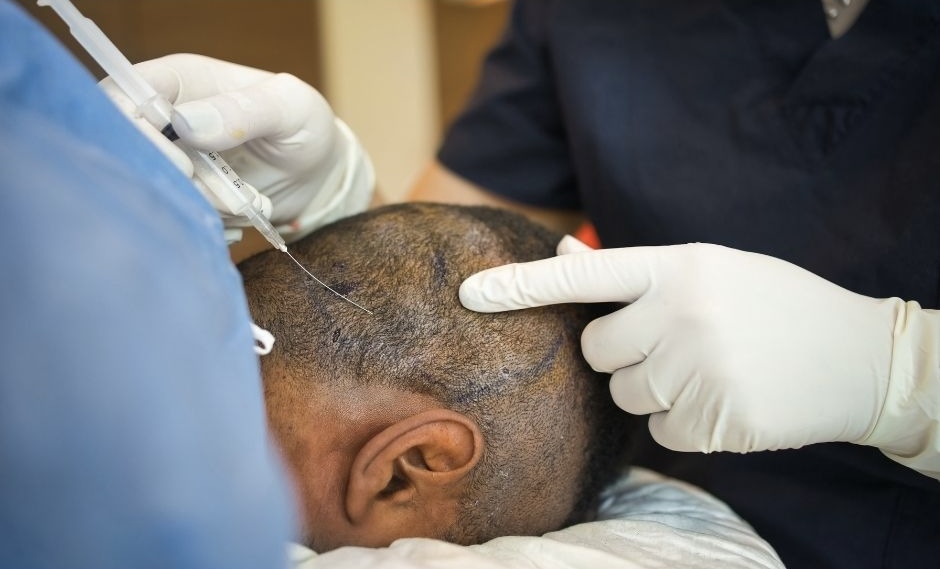
A hair transplant does not create new hair. It redistributes a fixed, non-renewable supply of it. Every graft moved from the back of your head is one you can never move again. That single fact determines who should have surgery and who should wait — or never have it at all.
Four filters matter.
Filter 1 — Do you have enough donor hair?
The safe donor zone is a band around the back and sides of the head where follicles are DHT-resistant. It is not unlimited. A typical scalp holds roughly 6,000 to 8,000 harvestable grafts over a lifetime, and drawing on more than that leaves the donor area visibly thin.
What a surgeon measures:
- Donor density — follicular units per cm², measured with a densitometer. Above 80 FU/cm² is strong; below 60 is limited.
- Hairs per unit — a donor area averaging 2.4 hairs per graft yields far more coverage than one averaging 1.8.
- Hair calibre — shaft thickness matters enormously. Coarse hair covers roughly twice the scalp per hair that fine hair does.
- Colour contrast with your scalp — light hair on pale skin looks fuller at the same density than dark hair on pale skin, because there's less visible contrast with the scalp beneath.
- Scalp laxity — a mobile scalp allows a strip; a tight one favours FUE.
- Donor stability — is the donor area itself showing miniaturisation? If it is, the 'permanent' zone may not be permanent, which is a warning sign for diffuse unpatterned alopecia.
Filter 2 — How old are you, and has the loss settled?
This is where most bad outcomes originate. A 22-year-old at Norwood II who has surgery may look excellent at 24 — and at 32 have a transplanted island of hair sitting in front of a bald crown, with the donor supply already partly spent.
The problem is that pattern loss is progressive and its endpoint is not knowable in advance. Surgery treats the scalp you have today; genetics keeps working on the rest.
- Under 25: most responsible surgeons decline, or offer only conservative work behind a mature hairline, and insist on medical therapy first.
- 25–30: possible, if loss has been stable for 2+ years on medication and family history suggests a limited final pattern.
- Over 30: the pattern is usually clearer, making planning far safer.
- Rapid loss at any age: stabilise medically first. Operating into actively shedding scalp risks accelerating the loss of surrounding native hair.
A surgeon who will operate on a 21-year-old with an aggressive family history and no medication is not being accommodating. They are selling you a problem you will pay to manage for the rest of your life.
Filter 3 — Is your diagnosis right?
Transplantation only works for non-scarring loss with a healthy donor zone. Conditions where surgery is inappropriate or must be deferred:
- Alopecia areata — autoimmune, unpredictable, and grafts can be attacked too.
- Active scarring alopecias — lichen planopilaris, frontal fibrosing alopecia, folliculitis decalvans. Must be documented as inactive for a long period, and results are still less predictable.
- Diffuse unpatterned alopecia (DUPA) — thinning that includes the donor zone. There is no safe donor area, so there is no operation.
- Untreated telogen effluvium — treat the trigger and wait; hair usually returns.
- Trichotillomania — hair-pulling. Grafts will be pulled out too. The behaviour is treated first.
- Body dysmorphic disorder — a real and under-recognised issue in this field, where no surgical result will satisfy the patient.
Filter 4 — Are your expectations reachable?
The best technical result in the world produces an unhappy patient if it was sold as something it isn't. Realistic outcomes look like this:
| Expectation | Reality |
|---|---|
| Restore my hairline to age 18 | No. Age-appropriate hairlines sit higher and keep temple recession. A low, straight, teenage hairline looks obviously fake at 45 and consumes grafts you'll want later. |
| Full density everywhere | No. Expect 30–50% of native density in one pass; 50–70% is possible after two. |
| Cover a bald Norwood VI crown and front | Rarely both. Donor supply forces a choice, and the front frames the face, so it usually wins. |
| Never need medication afterwards | No. Transplanted hair is permanent; your native hair keeps receding without treatment. |
| Results by summer | No. Meaningful growth at 6 months, near-final at 12, fully mature at 15–18. |
| Zero visible sign of surgery | Realistically yes, at conversational distance, after a few months — but there will be scarring somewhere. |
Health and safety screening
Surgery is elective, so the safety bar should be high. Flag any of these before booking:
- Uncontrolled diabetes or hypertension — impairs healing and raises bleeding risk.
- Bleeding disorders, or anticoagulant and antiplatelet medication.
- Keloid or hypertrophic scarring history — significant for FUT especially.
- Active scalp infection, severe seborrhoeic dermatitis or psoriasis — treat first.
- Immunosuppression, or recent isotretinoin (many surgeons prefer 6 months clear).
- Smoking — meaningfully impairs graft survival through vasoconstriction. Stopping for several weeks either side is worth it.
Key takeaways
- Transplants redistribute a finite donor supply — roughly 6,000–8,000 lifetime grafts — rather than creating hair.
- One pass achieves about 30–50% of native density, which reads as 'full' but is not teenage thickness.
- Under 25 with unstable loss is the highest-risk profile. Stabilise medically and wait for the pattern to declare itself.
- DUPA, active scarring alopecias, alopecia areata and trichotillomania are contraindications, not challenges.
- A surgeon focused on your limits is doing their job. One focused on a booking discount is not.
All ten topics
- 1. Why Hair Actually Falls Out
- 2. FUE vs FUT: The Only Real Choice
- 3. DHI, Sapphire, Bio-FUE: Buzzwords Decoded
- 4. Are You Actually a Good Candidate? (you are here)
- 5. How Many Grafts Do You Actually Need?
- 6. The 18-Month Timeline, Month by Month
- 7. Hairline Design: Where Results Are Won or Lost
- 8. Medication vs Surgery — Why You Need Both
- 9. Cost, Clinics and Hair Transplant Tourism
- 10. Risks, Complications and Real Recovery